The term "lie detector" is familiar to everyone — from movies, TV shows, and news. But few people know how this device actually works, what exactly it measures, and why its readings are considered reliable. In this article, we will take a detailed look at the entire process — from the physiology of human deception to modern data processing algorithms.
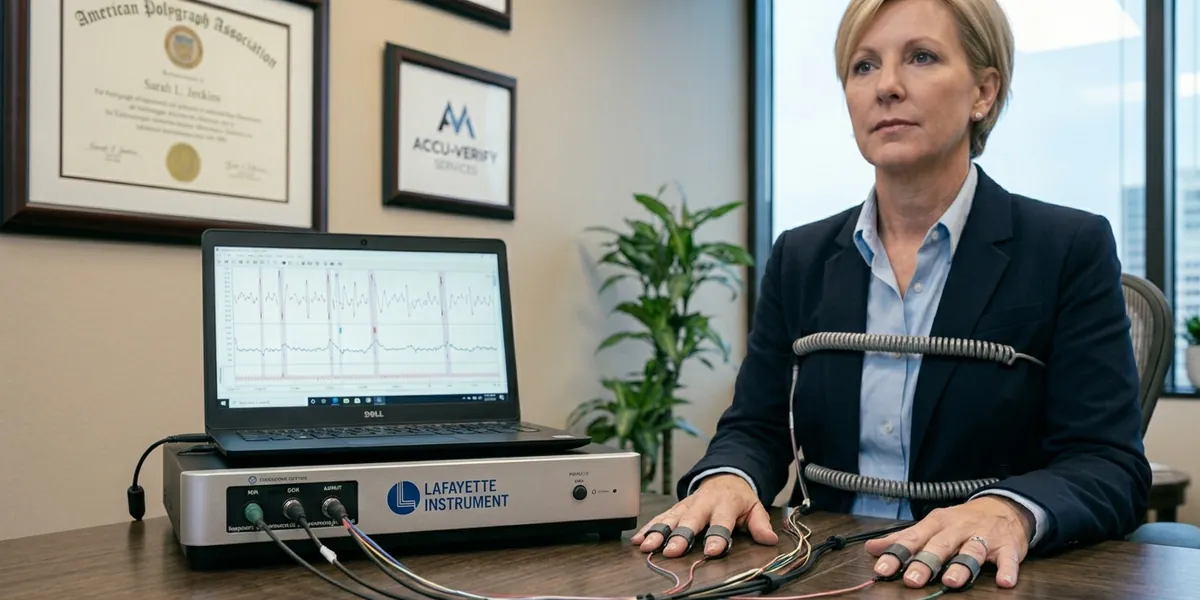
We will examine what happens in the human body when a person lies, what physiological processes the polygraph records, what modern equipment looks like, and how a specialist interprets the results. This article will be useful for anyone planning to take a polygraph test, order one for someone else, or simply wants to understand the science behind this technology.
Fact: Modern computerized polygraphs achieve an accuracy of 87-95% when validated techniques are used. This is confirmed by a meta-analysis from the U.S. National Academy of Sciences and numerous independent studies.
To understand how a polygraph works, you first need to understand what lying is from the perspective of neuroscience. When a person tells the truth, they simply retrieve a real memory and verbalize it. This is a relatively simple cognitive process.
When a person lies, the brain performs much more complex work:
This five-step model, described in research by neuroscientists Sean Spence and Daniel Langleben, explains why lying is always accompanied by increased brain activity. And it is this activity that triggers a chain reaction in the body.
The key role in lie detection is played by the autonomic (vegetative) nervous system — the part of the nervous system that controls processes occurring without conscious participation: heartbeat, breathing, sweating, and vascular tone.
The autonomic nervous system has two divisions:
| Division | Function | Activation during deception |
|---|---|---|
| Sympathetic | The "fight or flight" response — mobilizes the body in response to a threat | Increases: heart rate accelerates, blood vessels constrict, sweating intensifies |
| Parasympathetic | The "rest and digest" response — restores a calm state | Suppressed: the body cannot relax during deception |
When a person lies and realizes they might be caught, the brain perceives this as a threat. The sympathetic nervous system activates, triggering a cascade of physiological responses. And it is precisely these responses that the polygraph records.
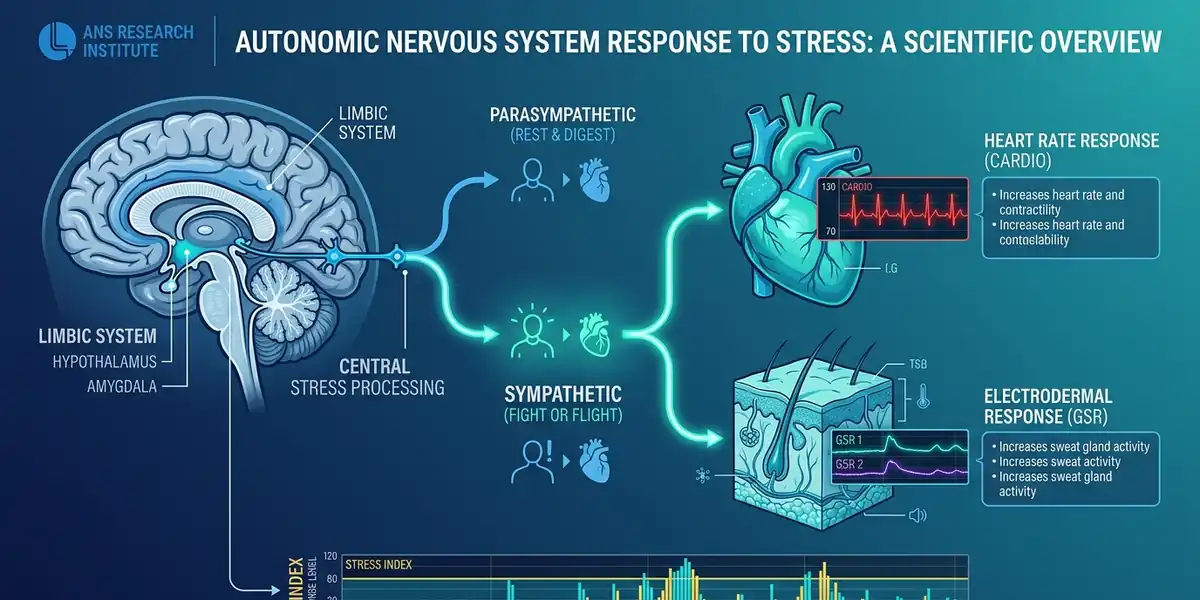
Activation of the sympathetic nervous system manifests in four main channels, each of which is recorded by a separate polygraph sensor:
This is the most sensitive detection channel. When a person experiences stress, the sweat glands on the fingers activate within 1-3 seconds. The mechanism is straightforward: stress → sympathetic system activation → stimulation of eccrine sweat glands → increased skin conductance.
Even a microscopic increase in sweating that the person does not feel is clearly recorded by the sensor. This explains why electrodermal activity is considered the "gold standard" in polygraph science.
During deception, the breathing pattern changes: it may become shallower, faster, or conversely — the person unconsciously holds their breath. These changes occur automatically and are very difficult to consciously control.
The polygraph records two respiratory channels simultaneously — thoracic and diaphragmatic — which makes it possible to detect even deliberate attempts at control.
The stress of lying leads to increased blood pressure and an accelerated pulse. The heart begins pumping more blood, preparing the body for a potential "escape" from the threat. These changes are recorded by a cardio cuff on the upper arm.
Modern polygraphs are equipped with pressure sensors on the seat that detect micro-movements of the body. During deception, people often unconsciously shift their body position, tense their muscles, or make micro-movements they do not notice.
Important to understand: The polygraph does not "read minds" and does not detect lies directly. It records the body's physiological responses that are statistically associated with deception. Interpreting these responses is the task of a qualified polygraph examiner.
A modern computerized polygraph is not a single device but a system of components that work together. Let us look at each of them:
This is the main hardware component to which all sensors are connected. It converts analog signals from the human body into digital data and transmits them to the computer. Modern sensor units have from 5 to 12 recording channels.
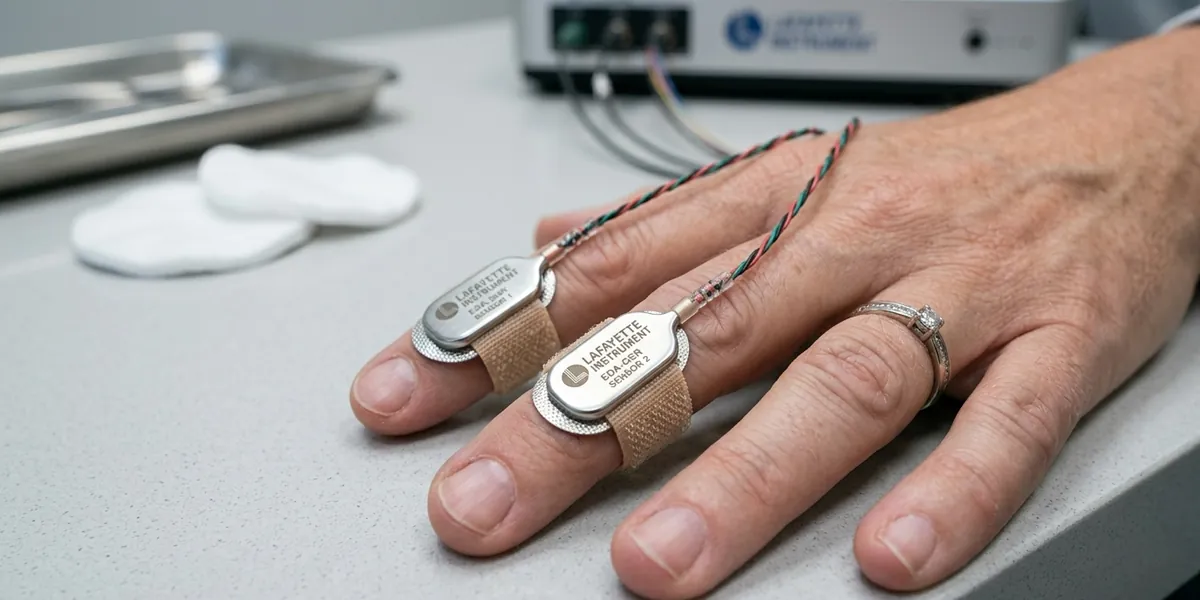
Each sensor is responsible for a separate physiological channel:
| Sensor | Placement | What it measures | Parameter |
|---|---|---|---|
| Pneumographs (2 pcs.) | Chest and abdomen | Expansion/contraction during breathing | Breathing rate, depth, and rhythm |
| Cardio cuff | Upper arm | Arterial pulsation | Blood pressure, pulse, blood volume |
| EDA sensors (2 pcs.) | Fingers | Skin conductance | Sweating level and changes |
| Plethysmograph | Finger | Blood volume in vessels | Vasomotor activity |
| Motion sensor | Seat of the chair | Body pressure on the surface | Micro-movements, posture changes |
All data from the sensors is transmitted to a computer, where specialized software visualizes them as polyline graphs — polygrams. Each channel is displayed as a separate curve on the screen. The software also allows the examiner to:
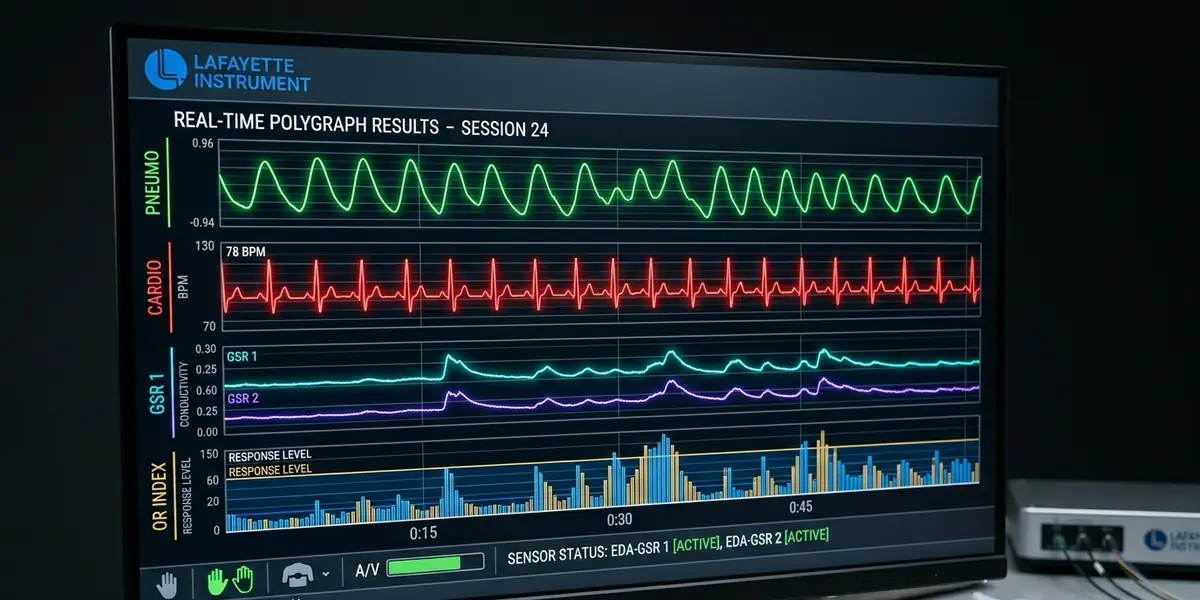
You can learn more about the types of equipment used for polygraph examinations in Ukraine on the corresponding page of our website.
A full polygraph test is a structured process consisting of several mandatory stages. The total duration ranges from 1.5 to 3 hours.
This is the longest and arguably the most important stage. During the pre-test interview, the polygraph examiner:
Why are questions shown in advance? This is not a weakness of the method but its strength. When the person knows the questions, the element of surprise is eliminated. An innocent person calms down because they understand nothing unusual will happen. A person who is lying, on the contrary, experiences heightened anxiety knowing that a specific question will be asked. It is precisely this contrast that the polygraph records.
The polygraph examiner places sensors on the examinee's body:
The attachment procedure is completely painless. No sensor pierces the skin or causes discomfort. The examinee sits in a comfortable chair.
An important detail: during attachment, the polygraph examiner explains the purpose of each sensor and checks whether everything is comfortable. If any component is pressing or causing inconvenience, it is adjusted. The examinee's comfort is not mere courtesy but a necessity: any physical discomfort creates "noise" in the data and can distort the examination results.
Before the test begins, the polygraph examiner performs calibration — establishing the individual baseline of a specific person's physiological indicators. This is a critically important step because every person has their own "normal" level of pulse, breathing, and sweating.
The baseline is determined using neutral questions that the examinee answers calmly and honestly. For example: "Is your name Oleksandr?", "Is it April right now?" These responses form a reference point against which subsequent reactions are evaluated.
The actual testing consists of several series of questions. Each series (chart) is a single pass through the full set of questions. Typically, 3-5 series are conducted to ensure statistical reliability.
During testing, the examinee answers only "yes" or "no." Questions are divided into three types:
| Question type | Purpose | Example |
|---|---|---|
| Neutral (N) | Filling pauses, adaptation to the procedure | "Are you currently in Ukraine?" |
| Control / Comparison (C) | Creating a reference reaction to a minor lie or discomfort | "Have you ever lied to someone to avoid trouble?" |
| Relevant (R) | Directly related to the subject of the examination | "Did you take money from the register on March 15?" |
An interval of 15-25 seconds is maintained between questions — the time needed for physiological indicators to return to the baseline.
After the testing is completed, the polygraph examiner analyzes the obtained polygrams. This process can be carried out in two ways:
The specialist compares reactions to relevant questions with reactions to control questions in each channel. The difference is rated on a scale from -3 to +3:
Scores are summed across all channels and series. The overall result is compared to threshold values established for the specific technique.
Modern software uses statistical algorithms for automated polygram evaluation. The most common algorithms include:
In most cases, the polygraph examiner uses both methods — manual and computerized — and compares their results. When they agree, the conclusion has high reliability.
After analyzing the results, the polygraph examiner conducts a concluding interview with the examinee. If signs of deception are detected, the specialist may ask whether there is anything the person would like to share or clarify. This is not an "interrogation" but an opportunity to clarify the situation.
Following this, a written report is prepared with a detailed description of the procedure, the technique used, and the results for each relevant question.
This is the most widely used technique in the world. Its logic is built on comparing two types of reactions:
Therefore: if reactions to relevant questions significantly exceed reactions to control questions, there is reason to believe the person is being deceptive. If control questions produce stronger reactions, the person is likely telling the truth.
This technique operates on a different principle. Instead of comparing control and relevant questions, the examinee is presented with a series of options, only one of which is correct (known only to the person involved).
For example, if a theft of a specific sum of money is being investigated:
An innocent person reacts to all options equally — they do not know the correct answer. A person involved shows a pronounced reaction to the correct amount because their brain "recognizes" the significant information — this is called the recognition effect.
This technique is often used in theft detection and in investigations conducted at an attorney's request.
Scientific advantage of CIT: This technique has the highest scientific validity among all polygraph techniques. A 2011 meta-analysis (Ben-Shakhar & Elaad) showed an accuracy of 85-95% in detecting involved individuals.
The question of polygraph accuracy is one of the most studied in forensic psychophysiology. Here are the key findings:
| Study | Accuracy | Notes |
|---|---|---|
| APA Meta-Analytic Survey (2011) | 87-95% | Validated techniques, qualified specialists |
| National Academy of Sciences (2003) | 81-91% | All techniques, varying specialist qualifications |
| Ben-Shakhar & Elaad, CIT (2003) | 85-95% | Concealed Information Test |
| Honts et al., CQT (2004) | 89-92% | Comparison Question Test in real cases |
The accuracy of a polygraph examination is determined by three key factors:
This is precisely why it is so important to turn to qualified specialists. The Ukrainian Polygraph Association guarantees that each of its specialists meets the highest quality standards.
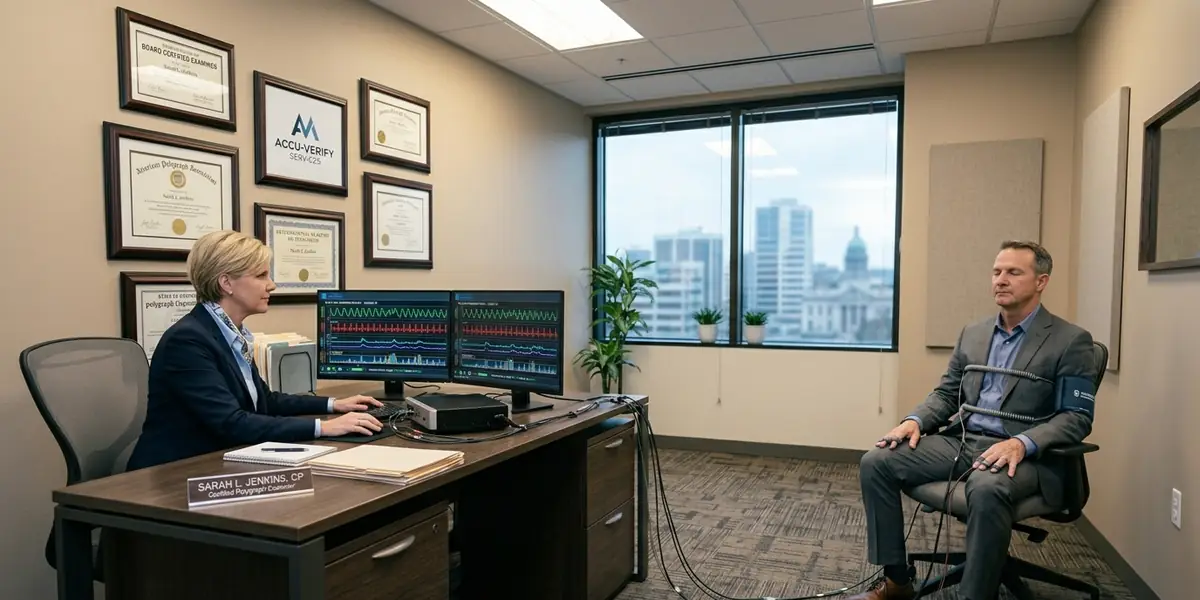
Polygraph examinations have a wide range of applications. In Ukraine, they are actively used by both individuals and businesses:
Individuals turn to a polygraph examiner most often in situations involving trust within the family or the protection of their rights. Each of these situations requires a delicate approach and a specialized technique:
The corporate sector uses the polygraph as a risk management tool. It allows companies to minimize financial losses, protect confidential information, and improve the quality of personnel selection:
The polygraph is a scientific instrument based on decades of research in the fields of psychophysiology, neuroscience, and statistics. It does not "read minds," but it records physiological responses associated with deception with high accuracy.
Key takeaways from this article:
If you are considering a polygraph test for any purpose — contact us. Specialists of the Ukrainian Polygraph Association work in Kyiv, Kharkiv, Odesa, Lviv, Dnipro, and other cities across Ukraine.
No. All sensors are placed on the surface of the body without any punctures or discomfort. The only noticeable element is the cardio cuff on the upper arm, which lightly squeezes the arm (like during a blood pressure measurement). The examination is conducted in a comfortable chair.
Most people report that after the first few minutes they stop noticing the sensors altogether. The procedure feels like an ordinary calm conversation in an office — without any painful or unpleasant sensations.
Nervousness is a normal state for any person taking a test. The polygraph examiner understands this and accounts for it. This is precisely why the pre-test interview and calibration exist — they allow the examiner to determine the individual "baseline level" of nervousness and compare reactions relative to it rather than against absolute values.
In other words, the polygraph evaluates not the absolute level of stress but the difference between reactions to different types of questions. Even if a person is very nervous, the difference between the reaction to a control question and a relevant question will still be noticeable. This makes the technique resistant to the examinee's general anxiety.
Yes. A polygraph examination in Ukraine is exclusively voluntary. No one has the right to force you to take a test. You can refuse at any time — even during the procedure.
Voluntariness is not a formality but a fundamental condition for a quality examination. If a person takes the test under pressure, their overall stress level is so high that distinguishing between reactions becomes significantly more difficult. That is why a professional polygraph examiner always ensures that participation is truly voluntary.
Yes, there are conditions under which the examination is not recommended or not conducted:
Before the examination, the polygraph examiner will always inquire about the person's health and medication use.
The full procedure takes from 1.5 to 3 hours, depending on the complexity of the topic and the number of questions. Do not trust specialists who promise to conduct a quality examination in 30-40 minutes — it is physically impossible while adhering to all standards.
The approximate time breakdown is as follows: pre-test interview — 30-90 minutes, attachment and calibration — 15 minutes, the actual testing — 20-40 minutes, post-test interview — 15-30 minutes. The longest stage is the pre-test interview, and shortening it to save time is a gross violation of protocol.
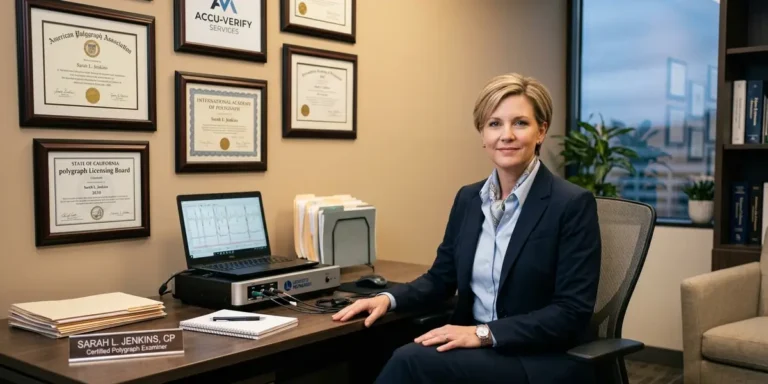
How to Choose a Reliable Polygraph Examiner: 7 Signs of a True Professional A lie detector test is a serious procedure...
Read more →

1
2