The Polygraph Examiners Union of Ukraine (SPU) carries out private lie detector tests throughout Spain — Madrid, Barcelona, Valencia, Malaga, Alicante and the coastal towns in between. Sessions are run in Spanish or English, with the preliminary conclusion given the same day.
In short: a private lie detector test in Spain costs €365 for a standard single-topic examination, runs 1.5–2.5 hours and delivers 95–98% accuracy. The examiner travels to Madrid, Barcelona, Valencia, Malaga, Seville, Alicante, Bilbao and the Costa del Sol and Costa Blanca resorts. The session is conducted in Spanish or English at no extra charge. A verbal conclusion follows immediately; the signed written report arrives within 3–5 business days and is included in the price. SPU examiners are listed in the official Register of Polygraph Examiners of Ukraine, and our local partner examiners work to the same protocols.
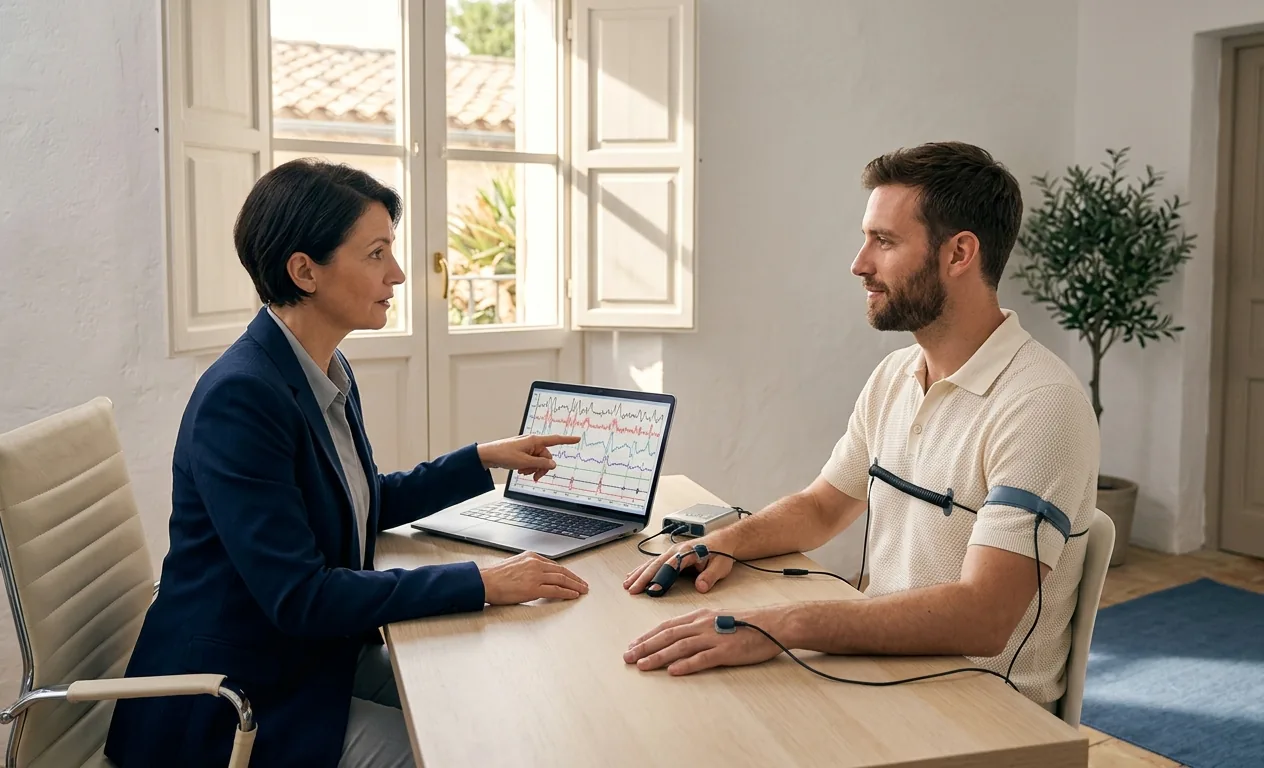
Property, tourism and household staff shape most of what we are asked about in Spain. A deposit is handed over before the paperwork is closed; a villa is left in the care of people the owners see twice a year; a restaurant hires eight people for the season and hands them the till on day one. Business is often done between parties who have never seen each other's documents.
Those conditions produce a particular kind of question — not vague suspicion, but a specific factual doubt with real money or a real relationship behind it. That is precisely what a polygraph examination is built to answer. Below are the requests we receive most often here.

Suspicion of an affair, a second life in another city, an explanation that keeps changing shape.
Infidelity test →
Housekeepers, nannies, carers and property managers who hold the keys while you are away.
Household staff vetting →
Money handed over for property, a business share or a private loan without watertight documents.
Borrower assessment →
A psychophysiological examination when your reputation is questioned and nothing can be shown either way.
Forensic testing →
Voluntary screening for positions with access to cash, stock and guests' belongings.
Personnel screening →
A changed circle of friends, substances, money disappearing at home, a story that keeps changing.
Teen testing →Three things generate most of our Spanish caseload. Property: money changes hands before the paperwork is finished, often through an intermediary nobody has checked. Households: a house stands empty for months while four people can legitimately enter it. Seasonal work: a hospitality team is assembled in April and gone by October, and every one of them handles cash or guests’ belongings from the first shift.
The fourth reason is the most personal one. A relationship under strain produces the same request everywhere — one factual question that two people cannot settle between themselves. In most infidelity cases the outcome confirms the person’s account, and what changes is that the argument stops restarting every evening. We work only on informed written consent, never behind a partner’s back, and any question can be withdrawn without explanation.
What all four have in common is the absence of a document. That is exactly the gap an examination fills: it will not tell you what someone feels, but it will tell you whether a specific thing happened.
A lie detector records several physiological channels at once — breathing, cardiovascular activity, blood pressure and electrodermal response. Concealment produces involuntary shifts that a person cannot suppress on command.
SPU examiners work to the standardised CQT and CIT protocols on professional equipment. Accuracy under protocol is 95–98%.
The situation is clarified and every question is worded and agreed with you, in your chosen language. There are no surprise questions later.
Written consent is signed first; the sensors are non-invasive and record nothing but your own physiology.
Yes/no questions repeated across several charts, so that one isolated reaction never decides the outcome.
Verbal preliminary conclusion the same day; the signed written report within 3–5 business days.
A lie detector does not read thoughts and does not identify a lie as such. It compares reactions to relevant questions against reactions to control questions, across four channels at once, and looks for a stable difference between the two. Because those responses are involuntary, they arrive before a person has finished deciding what to say.
A conclusion never rests on one spike in one chart: what matters is a pattern that holds across several presentations. That is what separates ordinary nervousness — which raises everything at once — from a concealment reaction, which is selective. The full mechanics are described in our guide to how a lie detector works.
A lie detector test answers factual questions about events: whether money was handed over, whether a meeting took place, whether something was concealed at hiring. It does not measure feelings, forecast future behaviour or establish who behaved better in an argument. Anyone promising that is describing something other than a polygraph.
This is why the interview counts for more than the equipment. A fair share of enquiries end with us saying that two or three precisely worded questions will do the work of fifteen vague ones — or that testing is simply the wrong instrument for the situation. That conversation costs nothing and happens before any booking is made.
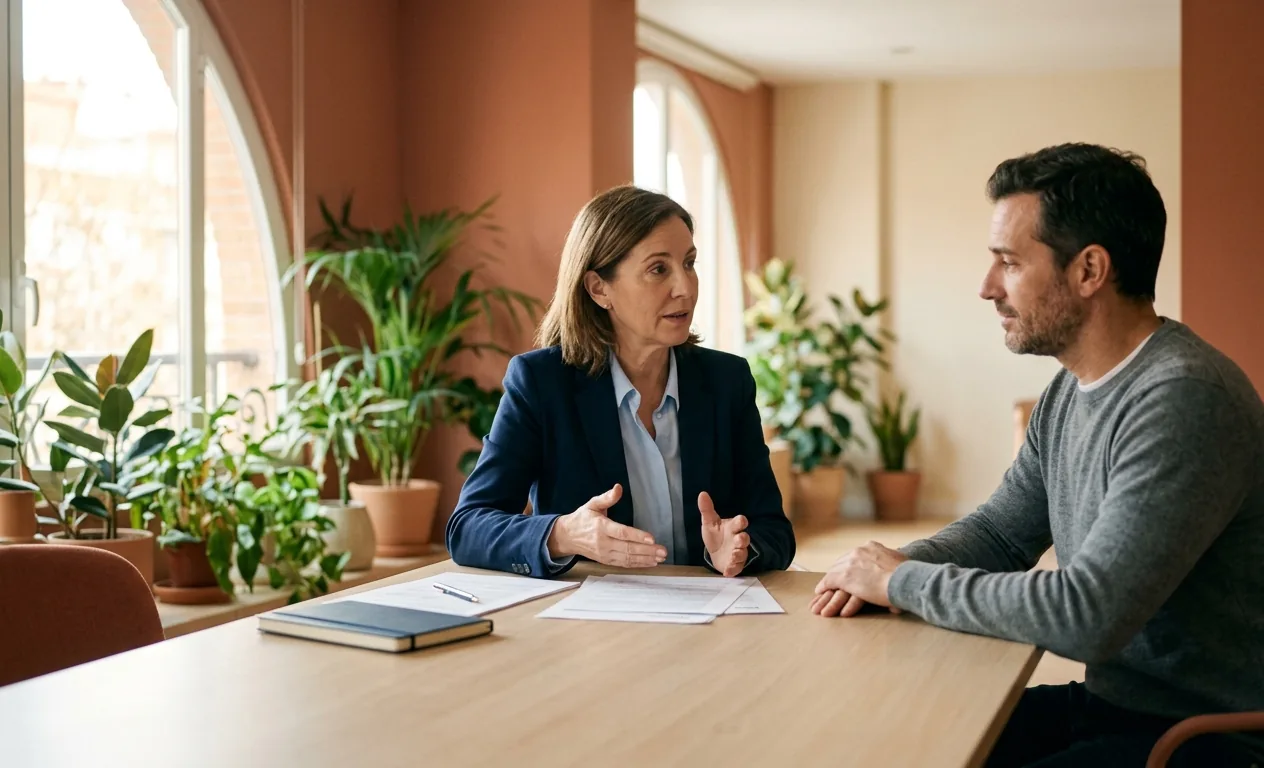
One transparent price for a standard lie detector test, not an hourly rate — you know the cost before booking. The preliminary consultation is free, the written report is included, and a session in Spanish carries no language surcharge.
| Format | What it covers | Price, EUR |
|---|---|---|
| Standard polygraph examination | One subject, one topic; 1.5–2.5 hours including the interview; written report included | €365 |
| Online-format examination | When the parties are in different countries and meeting in person is not realistic | €175 |
| Testing in a foreign language | Surcharge only outside our working languages — Spanish and English are included | +€80 |
| Multi-topic or corporate examination | Several respondents, an internal investigation, urgent scheduling | Quoted individually |
The standard price covers most private requests — resolving a family conflict, a check before marriage, establishing who took what, an examination at a lawyer's request and a visit by the examiner to your address. Company formats such as an internal investigation or a scheduled staff check are costed per case, since the workload depends on the number of people involved.
Prices are indicative and confirmed after the free consultation — the final figure depends on the number of topics, the number of respondents and the location of the session.
| Criterion | SPU | Independent examiner |
|---|---|---|
| Certification | ✓ Entry in the official register | Varies; often unverifiable |
| Methodology | CQT + CIT, standardised protocols | Down to the individual |
| Languages of testing | Four, agreed in advance | Usually one |
| Quality control | Charts can be reviewed by a second examiner | None |
| Confidentiality | Documented procedure and consent forms | Not regulated |

Spanish cases are handled by local certified partner examiners of the Polygraph Examiners Union of Ukraine. The choice depends on the subject: money and corporate matters and delicate family situations call for different experience.
Both work to SPU methodology and under the union's quality control: the question list is agreed in advance, the charts can be re-read by a second examiner, and the conclusion is issued on a union form. We name the examiner assigned to you when the appointment is confirmed.
Describe the situation and we will say honestly whether an examination will answer it. The consultation is free.
Get a consultationA buyer handed a five-figure deposit to an intermediary who promised to hold it until completion. When the sale collapsed, the money did not come back and the explanations changed weekly. Both sides agreed to a lie detector test rather than a cross-border claim, and the session established what had actually happened to the funds. The matter was resolved by agreement in under a month.
The owners of a property that stands empty for eight months of the year discovered items missing from a locked room. Four people had legitimate access — a housekeeper, a gardener, a pool technician and a property manager. All four agreed in writing to a voluntary check. One session narrowed the matter down, three people were cleared and kept their jobs, and the owners avoided accusing the wrong person on the strength of a hunch.
A fortnight of work away, a phone left face down and one late reply had produced eight months of the same argument. Neither of them could prove anything, and both were exhausted by it. They agreed on the questions together and took the test on the same afternoon; the result confirmed his account and, more importantly, gave them back the evenings they had been spending on it.
Three relatives sharing an inherited flat fell out over money that disappeared from a common fund. The accusations were destroying a family that had been close for decades. A voluntary examination cleared two of them and identified a misunderstanding rather than a theft — the money had been spent on a repair nobody had been told about. The family stayed intact, which had looked unlikely a month earlier.
Nobody arranges this kind of appointment lightly, and a lie detector test is not something clients want discussed afterwards. Discretion here is built into the procedure rather than promised in passing.

Standardised CQT and CIT protocols on professional equipment

Both are working languages for our examiners, with no surcharge for either

Madrid, Barcelona, Valencia, the Costa del Sol and Costa Blanca, or your own address

Verbal conclusion right after the session, signed report in 3–5 business days

Written consent, a private setting and a documented confidentiality procedure

SPU-certified examiners working to union protocols and quality control
Companies here use lie detector tests in a narrow and well-defined way: to clarify a specific incident such as a shortage or a leak, to screen candidates for roles with access to cash, stock or guests' property, and to run periodic checks agreed in advance with the people concerned. Seasonal hospitality and property management — sectors where staff turn over quickly and hold keys to other people's homes — account for most corporate enquiries we receive in Spain.
In every case participation is voluntary, consent is informed and in writing, and personal data collected during the process is handled under normal data-protection duties. A result informs a management decision; it does not replace a fair internal procedure, and we will say so to any client who expects otherwise.
Group testing. For five respondents or more we agree a per-case rate and a schedule that does not stop the working day. Ask in WhatsApp or Telegram — we reply the same day.
Sessions are arranged in Madrid, Barcelona, Valencia, Seville, Malaga, Alicante, Bilbao, Zaragoza and Palma, as well as in the resort towns of the Costa del Sol, the Costa Blanca and the Balearic Islands — Marbella, Torrevieja, Benidorm and their neighbours. Our Madrid address is Calle de José Ortega y Gasset 22–24, 28006; in practice most clients prefer the examiner to come to them.
Any quiet closed room of about 10 m² is suitable: a room at home, a meeting room, a rented office or a hotel room. Privacy and two uninterrupted hours are the only real requirements.
When we reply: messages on WhatsApp, Telegram and Viber are answered daily, 07:00–21:00 local time.
You receive a signed report from a certified examiner, describing the methodology, the questions agreed in advance and the conclusion. It is used most often outside a courtroom — in private disputes, negotiations between partners or relatives, internal company decisions and family situations where someone wants a documented account of their own position. Whether such a report can be added to court materials depends on the jurisdiction and the type of proceedings, so discuss your specific case with your lawyer first and we will prepare the examination in the format they ask for.
Nothing needs rehearsing before a lie detector test. Sleep normally, avoid alcohol and sedatives the day before, eat as usual and allow enough time so that you are not arriving in a hurry after a drive along the coast. Prescribed medication is not an obstacle — mention it during the interview and the examiner will factor it in, as they do routinely.
Nerves are expected and spoil nothing: every question will have been seen and approved by you, and the method is designed to separate ordinary anxiety from a concealment reaction. Attempting to control your breathing, on the other hand, is plainly visible on the chart.
A lie detector test is safe and painless, but a few conditions make a result unreliable: acute cardiovascular or neurological illness, pregnancy, acute stress or bereavement, and alcohol or sedatives taken within the previous day. Anyone under 18 is tested only with the written consent and presence of a parent or guardian.
The examiner checks for all of this during the mandatory pre-test interview, so candour there matters more than anywhere else in the process. If you feel unwell on the day, moving the appointment costs nothing and protects the accuracy of the answer you came for.
A standard examination costs €365 — one subject, one topic, 1.5–2.5 hours including the pre-test interview, with the signed written report included. The online format is €175. Multi-topic and corporate cases are quoted after the free consultation.
Yes. Spanish and English are both working languages for our examiners and neither carries a surcharge. The wording of every question is agreed with you beforehand in the language of the test, which matters more here than anywhere else — an ambiguous translation produces an ambiguous chart.
Madrid, Barcelona, Valencia, Seville, Malaga, Alicante, Bilbao, Zaragoza, Palma and the resort towns of the Costa del Sol and Costa Blanca. The examiner travels to the address you name — a closed room of about 10 m² at home, in an office or in a hotel is enough.
Usually within a few days in the largest cities, and with a little more notice for the islands and smaller towns. Tell us your location when you write and we will name the earliest realistic date.
The report works best outside a courtroom — in private disputes, negotiations and internal company decisions. Whether it can be added to court materials depends on the jurisdiction and the type of proceedings, so agree the format with your lawyer before booking and we will prepare the examination accordingly.
No. Participation is voluntary in every case and requires informed written consent. An employer may propose an examination, but a refusal is not in itself grounds for a disciplinary outcome, and the result cannot replace a fair internal process.
It occurs in a small share of cases — usually because of a medical condition, medication, or a topic worded too broadly to test cleanly. We say so plainly instead of presenting an unclear chart as an answer, and depending on the reason we either reword the questions and repeat the relevant part at no extra charge, or advise that a polygraph cannot settle this particular question.
Yes, on three conditions: written consent and the presence of a parent or legal guardian, genuine willingness from the teenager, and an adapted question set. If the young person refuses, we do not run the session.
Free consultation — we will match the format, the language and the examiner to your situation
Describe the situation in a couple of sentences. We will come back to you, say honestly whether an examination will answer your question, and name the price and the nearest available date. The consultation costs nothing and commits you to nothing.
Prefer to write? Any of these reaches us directly:

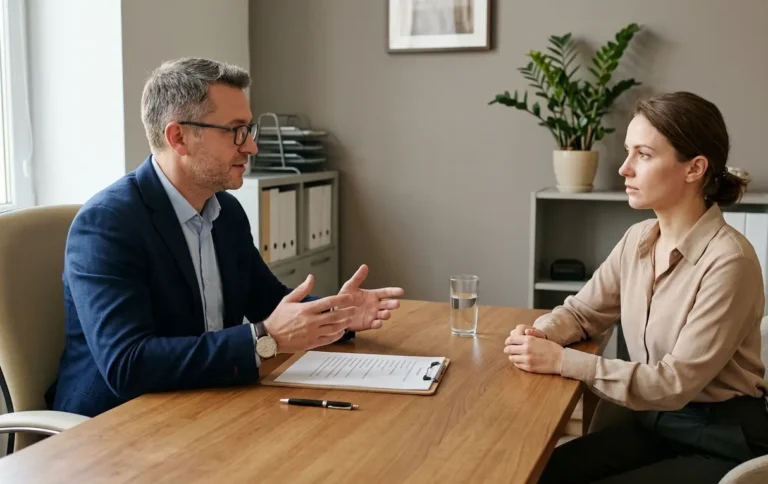
What Questions Are Asked on a Polygraph: Types, Examples and What You Cannot Ask Editorial Team, Polygraph Examiners...
Read more →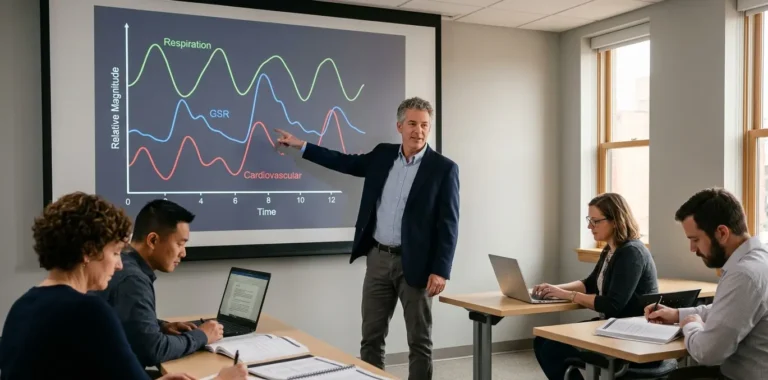
How to Become an Expert Polygraph Examiner: Training, Certification and the Path to Professionalism Editorial Team,...
Read more →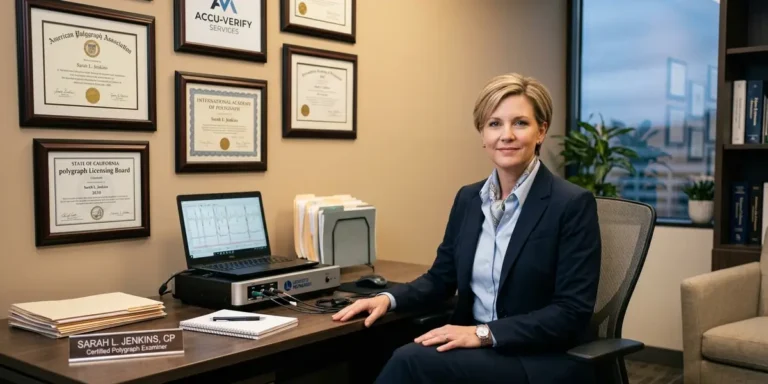
How to Choose a Reliable Polygraph Examiner: 7 Signs of a True Professional A lie detector test is a serious procedure...
Read more →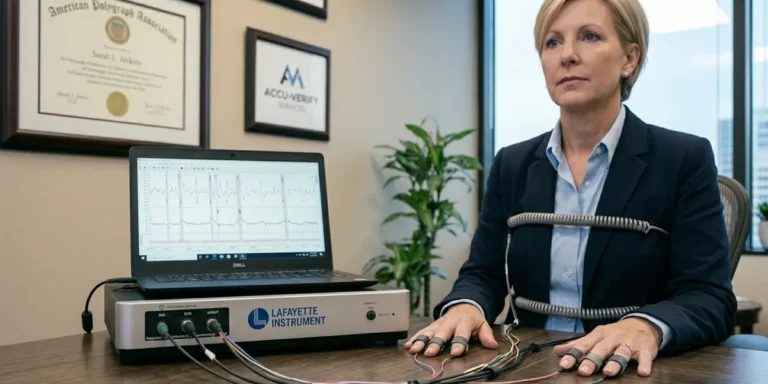
How a Lie Detector Works: Physiology, Technology, and Stages of a Polygraph Test The term "lie detector" is familiar to...
Read more →Certified SPU examiners work across Europe, Asia and North America — choose your country


1
2