Denmark runs on trust. Agreements here are often kept by word rather than by supervision, which is precisely why deception lands harder than it does in countries built on paperwork — the dispute turns personal within days. A lie detector test in Denmark gives people a way to close that dispute without public accusations and without losing a season to speculation.
An examiner from the Union of Polygraph Examiners of Ukraine travels to Copenhagen, Aarhus and Odense; for the islands and smaller towns the session can be held remotely. The interview and the examination are conducted in English, Russian or Ukrainian, whichever the participant follows comfortably. Accuracy is 95–98 per cent, the verbal conclusion comes the same day and the written report within three to five working days.
Requests split roughly in half. One half comes from families and couples, the other from small companies where everybody is visible and a single suspicion contaminates the entire team.
Worth knowing: the method deals with facts, not with character. “Did you take money from the safe in March” is a workable question; “are you an honest person” is not.
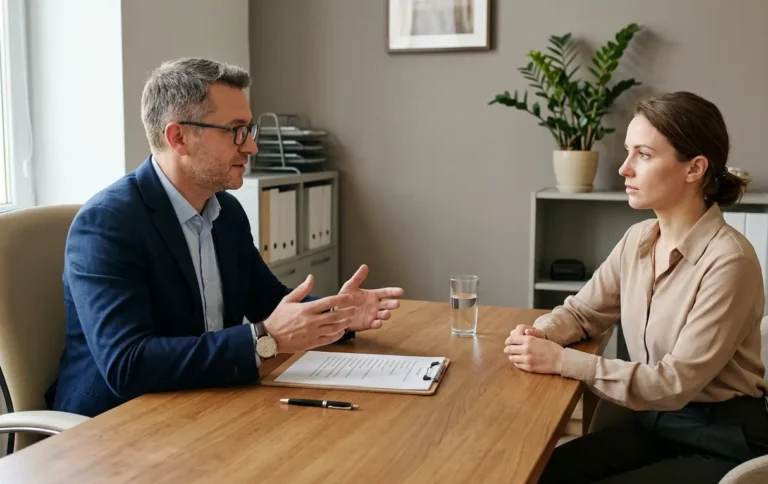
An appointment lasts between ninety minutes and three hours, and the first half is conversation. The examiner works out what has to be established, which episodes matter, and how to phrase each question so it cannot be read two ways. The participant hears the full list before anything is recorded.
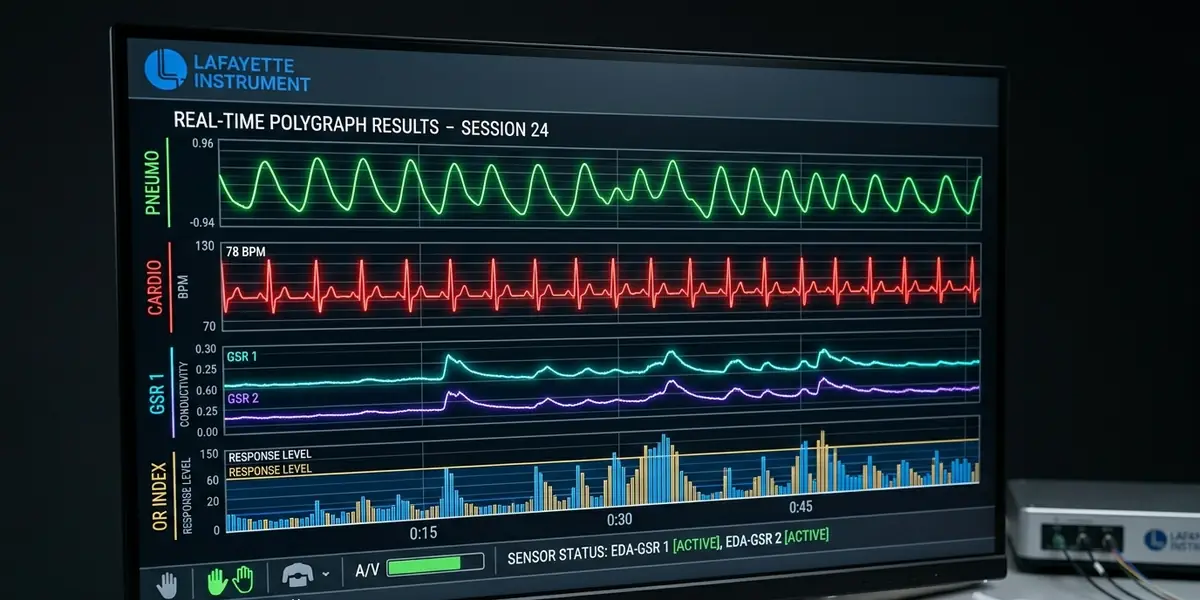
Then comes the consent form, and only after that the sensors. Breathing, pulse, blood pressure and skin conductance are recorded at once; none of them answers to willpower. The examiner reads a repeated pattern across several series rather than a single spike. Our hardware is listed on the equipment page.
An unpaid first conversation in which we say plainly whether the method fits.
Settling the date, the city and the room where the session will run.
Drafting the questions and reading them aloud to the participant.
A signature on the consent form.
Measurement, broken into short series.
A spoken answer that day, the document within three to five working days.

The fee reflects the format and the number of topics. Scandinavia costs more than southern Europe because of travel and room rental, and the figures below already account for that.
The written report is included. Where there are too many topics for one sitting, the work is split across two days at a price agreed in advance — nothing appears on the invoice afterwards.
Tip: plan two or three participants for the same day. The examiner’s travel is then paid once, which changes the total noticeably.
| Service | Price | Duration |
|---|---|---|
| On-site session | €425 | 90–180 min |
| Remote session | €175 | 30–60 min |
| Examination conducted in English | +€80 | surcharge |
We hold no permanent premises in the country and prefer to say so upfront. There are three workable options.
Travel across Denmark is agreed case by case: distances are short, but ferry timetables and the examiner’s calendar both affect the date. Writing to us earlier simply leaves more slots to choose from.
Denmark has no statute dedicated to examinations, yet its employment law protects workers more closely than the European average. The Danish act on the use of health information in the labour market expressly bars an employer from collecting or using medical data about an employee in order to assess the risk of future illness.
For our work that sets a simple frame, and we do not work around it:
Where the aim is to clear somebody of an accusation, the report is prepared in a fuller format — that scenario is described on our page about protecting honour and dignity.
Important: we give no legal guarantees and never promise that an employer or a court will accept the conclusion. The examiner answers for method and for an honest reading of the charts.
What you end up with is a five-part report: who commissioned the test and who took it, with the date and purpose; the full list of questions as agreed; an assessment of each one; the examiner’s note on what should be checked by other means; and a signature.
Polygram charts and a methodology description are attached on request. Where the data does not resolve cleanly, the report says so instead of offering a tidy answer. Credentials can be verified in the register of examiners.
Employers here almost never start from an accusation. The brief sounds different: find out what happened and keep the team intact. For that reason the examination is offered to everyone concerned on the same terms, and only to those who agree to it.
| Situation | What the examination adds |
|---|---|
| A shortfall in a small firm | A narrower circle, reached without searches or public blame |
| Hiring into a position of trust | CV details and reasons for leaving earlier jobs, verified |
| Leaked information | A focused look at the people who genuinely had access |
| Conflict inside the team | A way to clear the person who had nothing to do with it |
| Routine checks | Prevention: the possibility of a test is usually enough |
The individual scenarios are covered separately: personnel screening, internal investigations, theft detection and scheduled staff checks. Households have their own formats for vetting domestic staff and for testing a teenager.
Three storylines account for most enquiries. They share one feature: there is no formal proof, and the relationship has already soured.
A repair or service company of five people, part of the turnover in cash, the accounts kept in a spreadsheet. By the end of the quarter a sum is missing that cannot be written off as an error. The owner wants to keep every technician, so the test is offered to all of them on equal and voluntary terms.
A family hires a carer and within a month money and jewellery start disappearing. Suspicion lands on everyone with a key, relatives included. Here the examination more often clears somebody than confirms a suspicion, and that is its real value.
One partner works at sea or on a site with long shifts. Doubts build up over months while the conversation goes nowhere, because both are tired and repeating themselves. A single session on specific episodes brings the discussion back to facts.
A reliable reading requires an ordinary physical state, so we move the appointment when there is:
Tell the coordinator about regular medication at the booking stage; most of it changes nothing, but the examiner needs to know. Nerves are expected and harmless — anxiety sits evenly across the recording while a reaction to one question stands out.
In a small country a private matter becomes common knowledge quickly, so discretion counts for more here than almost anywhere. We do not disclose that an enquiry was even made, and appointments are scheduled so that the participant meets nobody they know.
When an employer books the test, we discuss voluntariness with them separately: if the consent looks less than genuine, the session does not happen. We raise that with the company rather than with the employee, so nobody is put on the spot.
Write briefly what happened and who needs to be tested. The coordinator will ask a few follow-up questions, propose a format and dates, and the wording is agreed with the examiner before the session. The consultation is free.
An on-site session starts at €425 and a remote one at €175, with €80 added for an examination in English. The price is higher than in southern Europe because of travel and room rental; the written report is included.
Copenhagen, Aarhus and Odense most often. Travel to other towns and to the islands is agreed when booking, since we keep no permanent office in the country.
Ninety minutes to three hours, half of it interview and agreement on the questions. You hear the conclusion the same day and receive the written report within three to five working days.
No. Danish employment law is strict on this: participation is voluntary, consent is written, and a refusal cannot be used as grounds for dismissal.
English, Russian and Ukrainian. Because the outcome depends on understanding each question precisely, the language is agreed before the appointment.
Accuracy is 95–98 per cent when the methodology is followed. If the data is ambiguous the examiner records that rather than choosing a convenient interpretation.
Yes, and it is a common request. The participant initiates the examination and then uses the report in a conversation with an employer, a team or a family.
Nothing changes. Anxiety does not distort the result, and preparing for the questions is impossible because they are read out before recording begins.
A certified examiner travelling to Copenhagen, Aarhus and Odense, remote sessions for the islands, accuracy of 95–98 per cent and a written report within three to five working days.
Request a callback

The areas our clients ask about most often. Open the one you need for the procedure, duration and pricing.
What Questions Are Asked on a Polygraph: Types, Examples and What You Cannot Ask Editorial Team, Polygraph Examiners...
Read more →
How to Become an Expert Polygraph Examiner: Training, Certification and the Path to Professionalism Editorial Team...
Read more →
How to Choose a Reliable Polygraph Examiner: 7 Signs of a True Professional A lie detector test is a serious procedure...
Read more →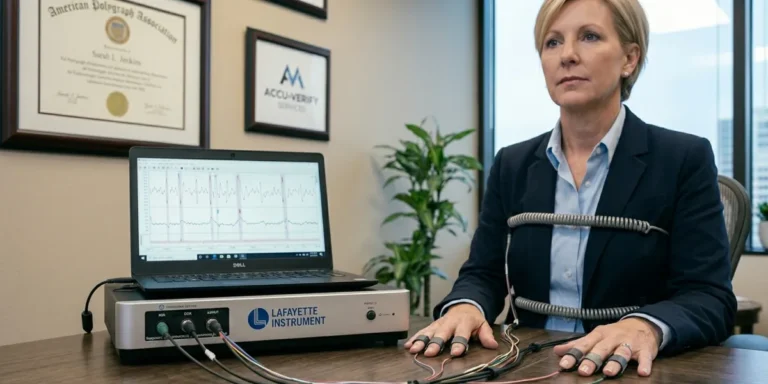
How a Lie Detector Works: Physiology, Technology, and Stages of a Polygraph Test The term "lie detector" is familiar to...
Read more →Certified SPU examiners work across Europe, Asia and North America — choose your country


1
2