The main fear before a lie detector test is uncertainty. What exactly will they ask? Can you refuse to answer? May the examiner ask any question at all? And what if you simply do not remember something? Movies, for example, show sudden and provocative questions. The news sometimes reports illegal wording in employment screenings. However, the real procedure works very differently. Moreover, it follows strict and repeatedly tested rules.
These rules are worth knowing in advance. After all, most of the anxiety comes from not understanding the procedure. Therefore, below we will cover several things in order. First, how polygraph questions are worded. Second, the three types of questions used in any method. Third, which topics are banned on ethical and legal grounds. In addition, which specific wordings apply in each field. So this article will help both those who plan to take a test and those who want to order a check for someone else.
In short. A polygraph uses three types of questions — neutral, relevant and control. The examinee sees and agrees to every wording in advance. Therefore, "surprise" questions do not exist. Questions are asked only in a "yes/no" format and about one fact at a time. A session includes 10–15 unique wordings. Moreover, each one is repeated 3–5 times. At the same time, it is banned to ask about political or religious views, discriminatory topics, or to provoke self-incrimination. Finally, the examinee may refuse any question or stop the test.
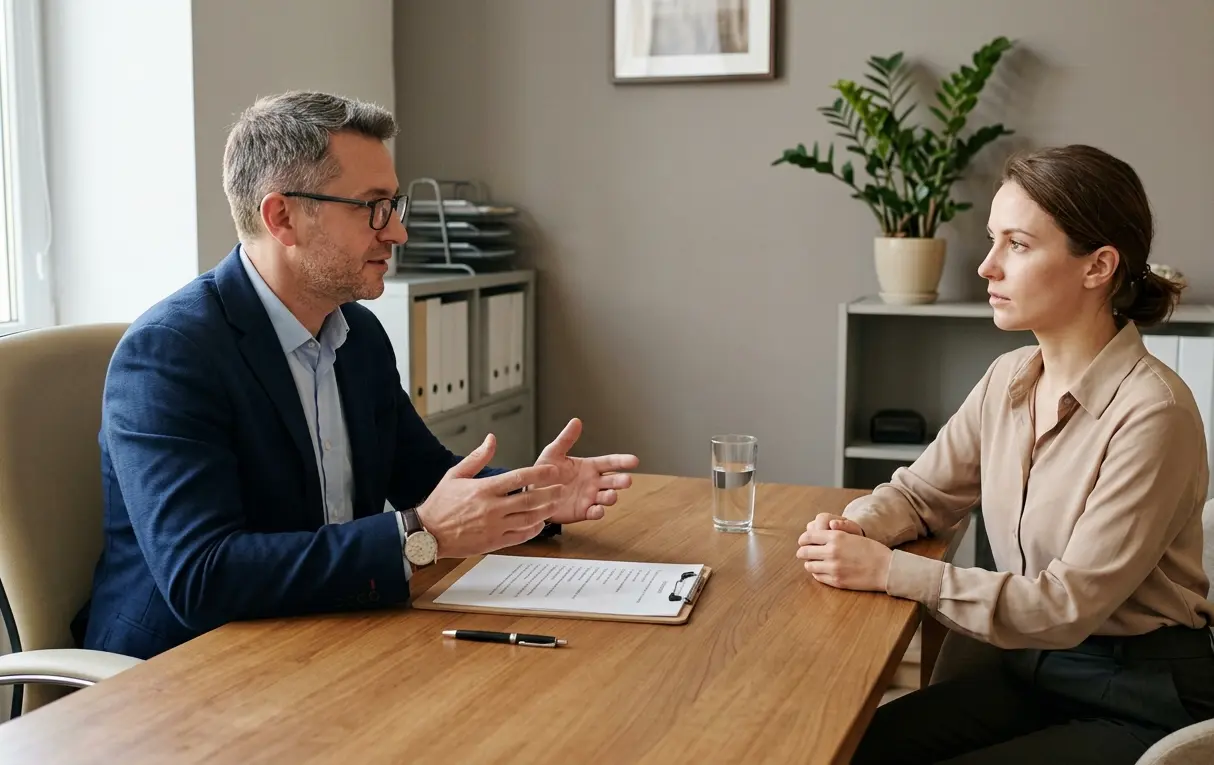
The key thing to know right away: the examinee knows every question in advance. This is a basic principle of any professional method. Therefore, no certified specialist will ask an unagreed question. And the "surprise questions" from movies are a plot device, not a real procedure.
Any professional procedure begins with a pre-test interview. It is a separate stage that lasts 20–90 minutes. It comes before the test itself. Moreover, it is often more important than the recording moment. First, the examiner gets to know the examinee. Then they explain the procedure and how the device works. Next, they record baseline physiological readings in a calm state. Above all, they go through the full list of questions with the client. So no question is heard for the first time during recording. This is an absolute rule. Breaking it makes any result unreliable.
This is not a formality or a courtesy. In fact, agreeing on questions serves several technical functions. Without them, the method simply does not work.
Informed consent. The examinee knows exactly what they agree to. Therefore, they can refuse any unacceptable topic before recording begins.
Correct wording. The examiner takes into account the examinee's vocabulary and understanding of terms. This matters especially when the test is not in a native language.
A stable state. This may be the most important point. Knowing what comes next removes the background stress of uncertainty. Otherwise, that stress would distort the baseline readings. As a result, interpreting the charts would become impossible.
The idea of "catching someone off guard" contradicts how the polygraph works. After all, the device records a physiological reaction to a stress stimulus. Suppose that stimulus is a sudden, shocking question. Then a reaction will appear in any person. At the same time, it does not matter whether they tell the truth or lie. Because of this, the polygraph records surprise or offence. However, it does not record the lie itself. So the examiner gets data that cannot be interpreted correctly.
That is exactly why validated methods work differently. CQT, CIT and R/I rely on repeated presentation of known questions. Each series is repeated several times. Only this way can a reaction to a significant stimulus be separated from general tension.
During the pre-test interview, the examinee may correct the wording. For example, they can ask to clarify terms or exclude certain topics. If a question sounds ambiguous, the examiner must rephrase it. If the examinee does not understand a word, the specialist picks a clear synonym. And if a topic falls outside the task, it is removed from the list. So this is a normal working procedure, not a "concession". It builds trust between the expert and the client before recording begins.
Tip: if a question feels incorrect to you, say so during the pre-test interview. After all, once recording starts, the wording can no longer be changed. Then the only option is a repeat test. And that means both time and money.
Nervous before the exam? During a free consultation, a PEUU specialist will calmly explain which questions will apply in your case. Moreover, they will ease unnecessary tension — with no obligations at all.
The topic of testing can be anything. However, all questions in a professional chart fall into three families. Their ratio and order depend on the method. At the same time, no test works without these three families. So understanding this classification removes all mystery from the procedure. In addition, it helps you speak with the expert about the test structure.
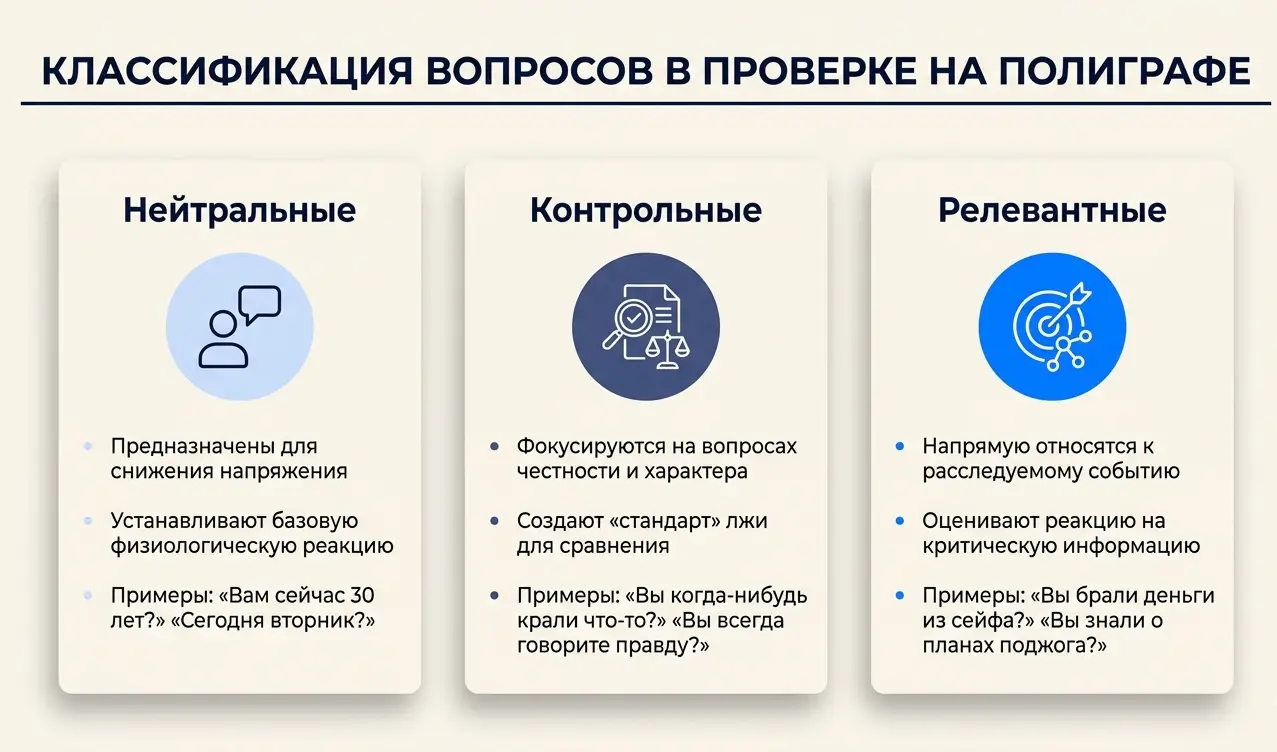
These are questions whose answers are obvious in advance. In addition, they are unrelated to the topic under study. For example:
Their purpose is to set a baseline level of readings. After all, the examinee answers truthfully without tension. Against this baseline, the examiner assesses deviations on significant questions. That is exactly why neutral questions are deliberately dull. However, it can also go differently. Sometimes a neutral question causes a strong reaction. Then this signals an unstable background state. So the expert must postpone the test or adjust the method.
This is the most important group in any test. In fact, the whole procedure is carried out for it. Such questions contain direct wording about the topic. For example:
The answers to them are the result of the test. After all, the main conclusion rests on the reaction to these questions. Therefore, wording relevant questions is delicate work. The question must be as specific as possible. At the same time, it cannot be too narrow. Otherwise, the examinee will technically dodge the answer. So good wording leaves no loophole for a "technical truth". That is exactly why experienced examiners discuss one action in two or three wordings.
This is the hardest category for an outside observer. A control question concerns a typical minor offence. Most people have committed it at some point. However, they do not want to admit it. For example:
The logic here is not obvious, but it is methodically sound. Consider an example. A truthful person answers "no" to the relevant question about the cash register. However, they tense up more on the control question. After all, almost everyone has taken something at some point. Therefore, denying that fact is harder. But a liar behaves the opposite way. They really did steal the money yesterday. Therefore, their peak tension is on the relevant question. So comparing these two reactions gives the main conclusion.
One caveat matters too. Control questions are used in the CQT method. However, the CIT method does not use them. There, a different logic works, based on presenting alternatives. Therefore, the examiner chooses the method based on the task.
| Type | Purpose | Example | Expected reaction |
|---|---|---|---|
| Neutral | Set the baseline | "Is today Wednesday?" | Minimal |
| Control | A "benchmark" reaction to a typical offence | "Have you ever taken something not yours?" | In a truthful person — higher than on the relevant one |
| Relevant | A direct question about the topic | "Did you take the money on March 12?" | In a liar — higher than on the control one |

Professional methods place several strict limits on wording. Breaking them makes the result unreliable. At the same time, it does not matter what the charts show. These rules come from decades of practice. In addition, many studies confirm them. Therefore, modern polygraphy treats them almost as dogma.
These five rules are not merely "best practices". In fact, they are technical requirements of the method itself. Breaking them makes the record of reactions uninterpretable. Moreover, even perfectly calibrated equipment does not save it. Therefore, no certified specialist steps outside these limits. So if the list contains a rule-breaking wording, it is a reason to talk before recording.
Important: suppose you do not understand a word in a question during the test. Then the test should be paused and the term clarified. This is normal and has no negative consequences. After all, an answer without understanding the question devalues the record. Therefore, an experienced expert is rather grateful for such a pause.
Below are sample wordings of relevant questions. They are grouped by broad thematic areas. However, this is not a ready-made script. Rather, it is a way to understand the general nature of tests. After all, the final wording is always individual. It is shaped during the pre-test interview for the specific situation.
This is the most frequent request in Ukraine and the diaspora — marital fidelity testing. The topic is painful. Therefore, the wording requires special tact. After all, even a correct question can hurt without preparation. Typical relevant wordings are as follows:
The final wording depends on the client's request. For example, it may be general fidelity, a specific episode or a full check.
Personnel screening is the most "standardized" area. After all, the wordings here are uniform. They apply to every candidate with minimal changes. Therefore, results are easy to compare across mass screening. The standard set of questions is as follows:
In large companies, screening is done regularly. For example, at hiring, at access upgrades or on suspicion.
An internal official investigation is the most "investigative" field. Here, work with questions is close to operational practice. Therefore, the questions are specific. In addition, they are tied to an event, date and object.
A simple relationship applies here. The more precise the claim, the more precise the list.
Need to order a check — on fidelity, staff or for an investigation? We will build a correct list of questions for your exact situation. Moreover, we run the test with visits across Ukraine or abroad. And you get the result on the day of testing.
This is a growing category of requests. Clients aged 25–35 are especially active. After all, for them transparency before the wedding has become the norm. Details are on the service page lie detector test before entering into marriage. Typical wordings are as follows:
This is a delicate category that requires separate ethical preparation. Testing is done only with the teenager's written consent. In addition, parents take part in shaping the questions. As a rule, the age threshold starts at 14. Details are on the service page a lie detector for testing a teen.
The main goal of such testing is not punishment. In fact, it is restoring family trust through objective facts.
Forensic psychophysiological testing is the most responsible field. Here, questions are worded at the request of a lawyer or investigator. In addition, the topic is tied to a specific event in the case.
The conclusion for such a test is issued as an official document. So it can be attached to the case file as a private expert opinion.
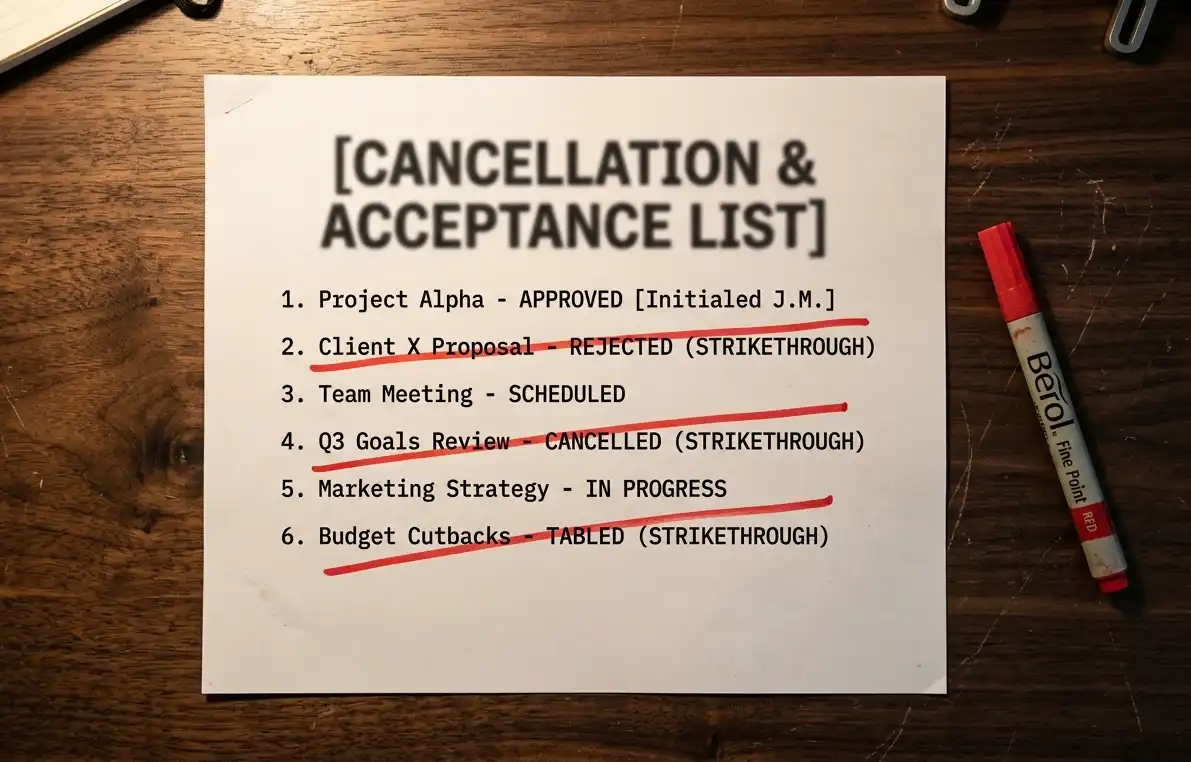
Not every question can be asked on a polygraph. This is not a theoretical limit but a working rule. It is set by the ethics code and national laws. Therefore, a certified specialist will refuse a banned wording. Moreover, this happens even after the contract and deposit.
In short, the list of bans looks like this:
Note: suppose your list contains banned wordings. Then this signals a low qualification of the examiner. In addition, it may point to bad-faith goals. Therefore, it is better to refuse and turn to a trusted specialist — for example, from the register of polygraph examiners.

Every situation has a huge space of wordings. They can be direct or indirect, broad or narrow. However, the examiner's task is different. They do not have to ask every possible question. Instead, they select 8–14 relevant wordings. These must cover the topic precisely. In addition, they must not duplicate one another.
Often the specialist first drafts 30–40 options. Then they narrow the list to a working one. For this, they apply four criteria. These are clarity, a link to facts, no ambiguity and no overlaps. So this work is half analytical and half creative. This is exactly where the "device operator" differs from a real expert.
Refusing to answer is an unconditional right of the examinee. It is set by the ethics code and the data protection law. Before the session, the person signs an informed consent. It states the right to stop the test at any time. Moreover, this is without explanation and without consequences. Therefore, any pressure to continue is a gross violation. So it is grounds for a complaint to the association and a lawsuit.
There is a nuance here. Technically, the examinee can stay silent. Then this is recorded as "no answer". However, there is an important point. If this happens during the test, a gap appears in the data. It affects the ability to draw a conclusion on the topic. Therefore, "uncomfortable" questions are better discussed in advance. For example, they can be excluded or rephrased. So this is a matter not so much of rights as of practical value.
This is a normal and common situation. The examiner must take it into account. Therefore, correct methods avoid questions about exact memory. For example, about dates or the order of minor events. However, it can also go differently. Sometimes a question still requires a "yes/no". Then the examinee answers "no" with a "do not know" note. On the chart, this gives a distinctive pattern. After all, a "do not know" reaction differs from "I know but hide it". And the skill to tell them apart is part of basic training.
This depends on the method and topic. Consider a standard CQT session. It includes 3–4 control and 3–4 relevant questions in a series. In addition, 2–3 neutral ones are added. The series itself is repeated 3–5 times for reliability. Therefore, a session may include 30–60 questions. However, only 10–15 of them are unique wordings. At the same time, the recording usually lasts 60–120 minutes. But the CIT method works differently. Here, series of alternative questions are presented. A significant reaction appears only to the "familiar" one. Therefore, the total number of presentations is larger — up to 100–150 per session.
Many myths have gathered around the polygraph over the decades. Five of them concern the questions. Moreover, they appear so often that they deserve a point-by-point debunking.
This is not true. The examiner works within the agreed topic. In addition, each question is discussed in advance. Suppose an unagreed question is heard during recording. Then the examinee may refuse and stop the session. After all, this is set in the signed consent.
This is not true. The polygraph checks only agreed topics. For example, the topic is theft in the office. Then questions about cheating or student years are not asked. After all, they are unrelated to the case. So the polygraph is a tool for targeted fact-checking, not a "biography detector".
This is not true. The method is built precisely against this. It tells general nervousness apart from a reaction to a significant question. That is exactly why three categories of questions are compared. With general nervousness, the reaction rises evenly. But with a lie, it rises selectively — on the relevant ones.
This is greatly exaggerated. After all, the polygraph records 5–8 independent channels:
Consciously controlling one channel changes the others. The examiner recognizes these compensatory changes. So the very attempt at countermeasures becomes a diagnostic sign.
This is not true. The most effective questions are direct and unambiguous. But tricky questions only complicate interpretation. Therefore, experienced specialists avoid them.
From the whole article, the main points are enough. They come down to five principles. They work for any professional procedure:
Understanding these principles removes most of the anxiety. After all, the polygraph is not an "interrogation". In fact, it is a structured study with transparent rules. Therefore, the better you understand the rules, the calmer the session. In addition, the more accurate the result. And this is not charity but a professional necessity. After all, only a calm person gives a clear physiological picture.
Want to shape your own questions for your situation? Then use the free consultation from the Polygraph Examiners Union of Ukraine. It is available daily from 08:00 to 22:00 — by phone at 0 800 336-909 or on Telegram/Viber/WhatsApp. We will help build a correct list for your task — from marital fidelity testing to an internal corporate investigation. Our experience is over 15 years. Our coverage is all of Ukraine, Europe and Asia.
In most methods — no. The examiner words the questions by topic. However, they do not know the actual answer before the test. The exception is the CIT method. There, the specialist knows the "correct" alternative from the case file. And the test determines whether the examinee knows it. So in CQT and R/I the task is different — to record the reaction.
Yes. This is a standard part of the pre-test interview. All questions are voiced and agreed before recording. In addition, the examinee can make corrections or exclude topics. But "secret questions you will learn during the test" are not a professional practice.
A standard CQT session includes 10–15 unique wordings. Each of them is repeated 3–5 times. Therefore, a test includes 30–60 presentations. However, these are the same 10–15 wordings. At the same time, recording usually lasts 60–120 minutes. And the CIT method can include up to 100–150 presentations.
Yes, absolutely. This right is set in the informed consent. Therefore, you can refuse a specific question or stop the test at any time. In addition, forcing an answer is a gross breach of the ethics code. However, keep one nuance in mind. If the refusal happens during the test, a gap appears in the data.
This is a normal situation. After all, correct methods avoid questions about exact memory. However, sometimes a question still requires a "yes/no". Then answer "no" and report your uncertainty. On the chart, a "do not know" reaction differs from hiding. Therefore, an experienced specialist interprets it correctly.
No. Ethics and law ban such questions. For example, about age, sex, ethnicity or health outside the topic. Political and religious views are banned too. Therefore, the examinee may refuse to take part. Moreover, this will not affect any decision in their favor.
No. After all, each question has one obvious truthful answer. Therefore, preparing a "convenient" answer is impossible. The polygraph measures not words but a physiological reaction. So when a person lies, the nervous system reacts on its own. Moreover, it does not matter how well the answer is prepared.
In the one the examinee speaks fluently. The PEUU tests in Ukrainian, Russian, English and Spanish. At the same time, the language does not affect accuracy. After all, the polygraph records physiology, not semantics. The key is that the person understands the question. Therefore, the interview always checks understanding of terms.

How to Become an Expert Polygraph Examiner: Training, Certification and the Path to Professionalism Editorial Team,...
Read more →
How to Choose a Reliable Polygraph Examiner: 7 Signs of a True Professional A lie detector test is a serious procedure...
Read more →
How a Lie Detector Works: Physiology, Technology, and Stages of a Polygraph Test The term "lie detector" is familiar to...
Read more →Certified SPU examiners work across Europe, Asia and North America — choose your country

1
2