
The Netherlands runs on short distances and long contracts. People move here for work, set up small companies, leave a family behind in another country — and mistrust tends to appear exactly at those seams. A lie detector test in the Netherlands is for the point where explanations have run out: there are several versions of events, no way to check any of them, and a decision that will not wait.
An examiner from the Union of Polygraph Examiners of Ukraine travels to Amsterdam, Rotterdam, The Hague and beyond; where travel makes no sense, the session runs remotely. Testing is available in English, Russian or Ukrainian, and the choice belongs to the participant rather than to whoever is paying. Accuracy is 95–98 per cent, the verbal conclusion comes straight after the session and the written report within three to five working days.
The mix of requests here differs from southern Europe. There is less of the holiday-season drama and far more that grows out of employment: agency work, subcontracting, warehousing, small service firms staffed by people from half a dozen countries.
Worth knowing: the instrument diagnoses nothing and reads no minds. It records a reaction to a question the participant has already heard and agreed with the examiner.
An appointment takes ninety minutes to three hours, and the conversation comes before the hardware. The examiner establishes what has to be clarified, which episodes carry weight, and how a question can be phrased so that it has one reading rather than three. The participant then hears the entire list, word for word.
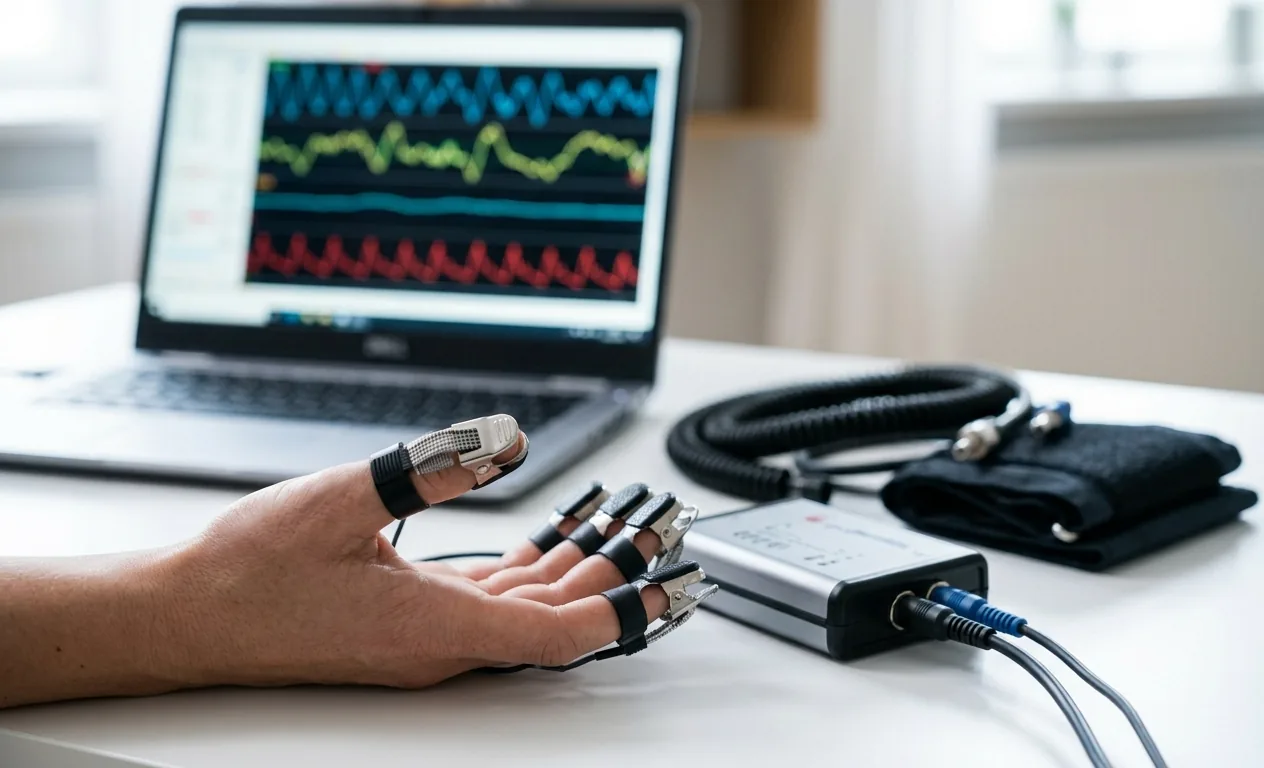
Sensors go on only after the consent form is signed. Breathing, pulse, blood pressure and skin conductance are recorded together, none of them being under deliberate control. One spike means nothing on its own; the conclusion rests on a pattern that repeats across series. The hardware itself is described on the equipment page.
A short call with the coordinator: what happened, who is being tested, what outcome you need.
Picking the place and the hour — a hired room, your own office or a video link.
Working on the questions with the examiner until each one has a single meaning.
The participant signs the consent form.
The recording itself, in short series with pauses in between.
A spoken answer on the day and the document by email three to five working days later.

Pricing follows the format and the number of separate topics to be covered in one sitting.
The written report is part of the fee, not an extra line on the invoice. If one appointment cannot hold all the topics, the coordinator says so in advance and the work is split across two days at a rate agreed beforehand.
Tip: companies testing several employees should ask for a single-day schedule — the examiner’s travel is then paid once instead of per visit.
| Service | Price | Duration |
|---|---|---|
| On-site session | €365 | 90–180 min |
| Remote session | €175 | 30–60 min |
| Examination conducted in English | +€80 | surcharge |
There is no permanent office in the country and we would rather say so plainly. The venue follows the case.
The country’s geography helps. From Schiphol most cities are under an hour away, so travel is rarely the obstacle; the examiner’s calendar usually is, which is why a date is best fixed several days ahead.
No Dutch statute deals specifically with examinations. What governs them instead is consent and European data protection law, which in day-to-day terms means four things.
Where the result may be used by a lawyer or in a dispute, mention it at the enquiry stage — the report is then drawn up in a fuller format, with the methodology spelled out. That version is covered on our page about examinations requested by a lawyer.
Important: we offer no legal guarantees and never promise that a given court or employer will accept the conclusion. The examiner is responsible for method and for reading the data honestly.
The deliverable is a report in five parts: the background to the case, the complete list of questions in their agreed wording, an assessment of each question, the examiner’s note on what should be verified by other means, and a signature.
Charts and a methodology description are attached on request, which is what lawyers normally need. Where the data genuinely does not resolve, the report states that rather than offering the convenient answer. Credentials are listed in the register of examiners.
For a business the point is to narrow the circle quickly without turning a whole shift into suspects. Logistics and warehousing come to us most often, followed by service firms with high staff turnover, small trading companies and family businesses where the owner and the employee are also relatives.
| Situation | What the test adds |
|---|---|
| A shortfall in the warehouse | A much smaller circle, without searches or public accusations |
| Hiring into a position of trust | CV claims and reasons for leaving earlier jobs, checked rather than assumed |
| Leaked deal terms | A look at the few people who actually had access |
| A dismissal that turned hostile | Clarity on what you are parting with and what to expect next |
| A new partner or investor | Intentions and willingness to deliver, beyond the paperwork |
Each case has its own scenario: personnel screening, internal investigations, checks when staff leave, checks before a deal, assessing a borrower and theft detection.
The first two sentences of an enquiry usually tell us how long the appointment will take and which topics have to be kept apart. Three storylines repeat more than the rest.
A distribution centre, two shifts, part of the workforce hired through an agency. A pallet is recorded as received and is not on the rack. The cameras show the unloading but not what happened afterwards. The people who handled the paperwork are tested on an identical set of questions.
Two people from the same community open a café: one puts in cash, the other time and contacts. A year later there is revenue, no bookkeeping and two incompatible accounts of who owns what. The examination does not replace an audit, but it does separate confusion from intent.
A husband working in Rotterdam, a wife and children who stayed behind. Video calls end the same way every time and nobody moves. One session built around specific episodes settles the matter faster than six months of mutual accusation.
A reading only holds up when the participant is in an ordinary state, so the appointment moves in these cases:
Long-term prescriptions rarely matter, provided the examiner hears about them at the booking stage instead of in the room. Nor do nerves: a steady background of worry looks nothing like the sharp change that one particular question produces.
Dutch practice treats personal data seriously and we work to the same standard. The enquiry is visible to the coordinator only, consent is signed by the participant in person, and recordings do not leave the closed archive without their agreement.
Where a company initiates the appointment, we state in advance that a refusal will not be read against the employee. That is part of the procedure rather than a courtesy: without genuine consent the result carries no weight at all.
Two sentences are enough to start: what happened and who needs to be tested. The coordinator comes back with a format and the nearest dates, and the questions are agreed later with the examiner. The first consultation is free.
An on-site examination starts at €365 and a remote one at €175, with €80 added when it is conducted in English. The written report is included and the coordinator confirms the final figure at booking.
Most appointments are in Amsterdam, Rotterdam and The Hague, but travel across the country is possible. We keep no permanent office here, so a room is booked or the examiner comes to your address.
Ninety minutes to three hours, with roughly half of that spent on the interview and on agreeing the questions. The verbal conclusion is immediate; the written report follows in three to five working days.
English, Russian and Ukrainian. Since the result depends on understanding every question exactly, the language is settled before the appointment.
No. Participation is voluntary, consent is signed in advance, and a refusal cannot be the sole basis for an employment decision.
Accuracy runs at 95–98 per cent where the methodology is followed and the participant is in a normal state. Ambiguous data is reported as ambiguous.
As a specialist opinion, yes; as standalone evidence, no. Say in advance if there is a legal purpose and the report will be prepared in the fuller format.
That changes nothing. General anxiety and a reaction to a specific question look different on the chart, and rehearsing is pointless because the questions are read out beforehand.
A certified examiner travelling to Amsterdam, Rotterdam and The Hague, remote sessions elsewhere, accuracy of 95–98 per cent and a written report within three to five working days.
Request a callback

The areas our clients ask about most often. Open the one you need for the procedure, duration and pricing.
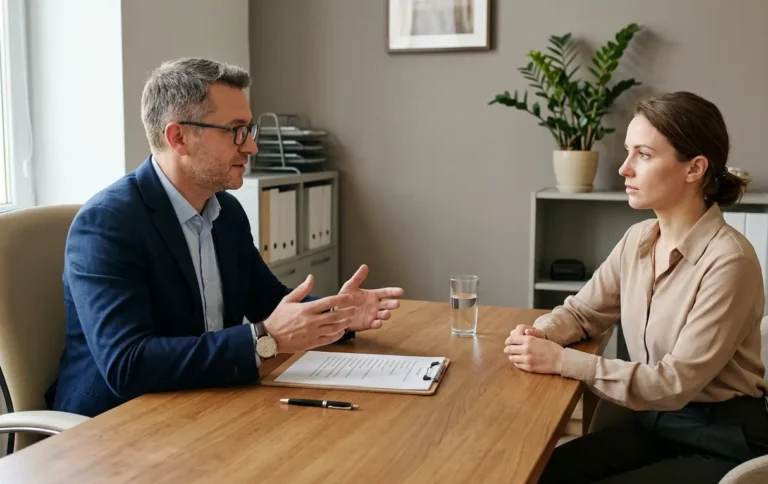
What Questions Are Asked on a Polygraph: Types, Examples and What You Cannot Ask Editorial Team, Polygraph Examiners...
Read more →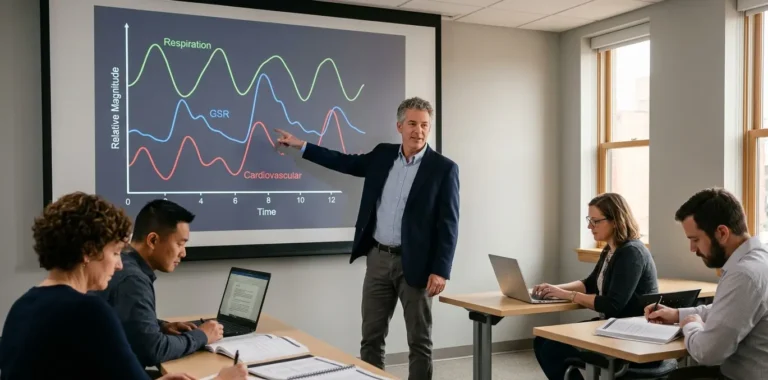
How to Become an Expert Polygraph Examiner: Training, Certification and the Path to Professionalism Editorial Team...
Read more →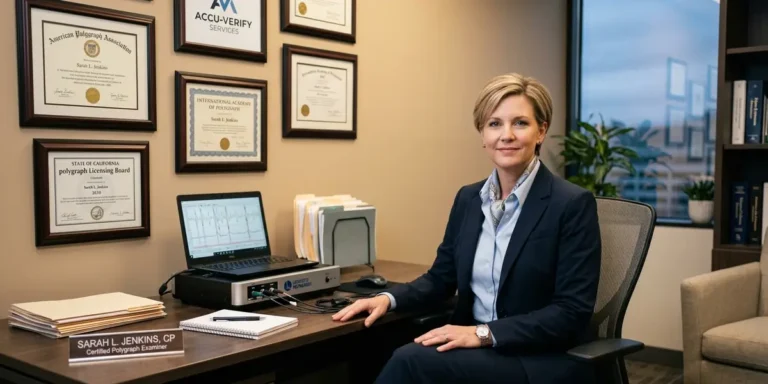
How to Choose a Reliable Polygraph Examiner: 7 Signs of a True Professional A lie detector test is a serious procedure...
Read more →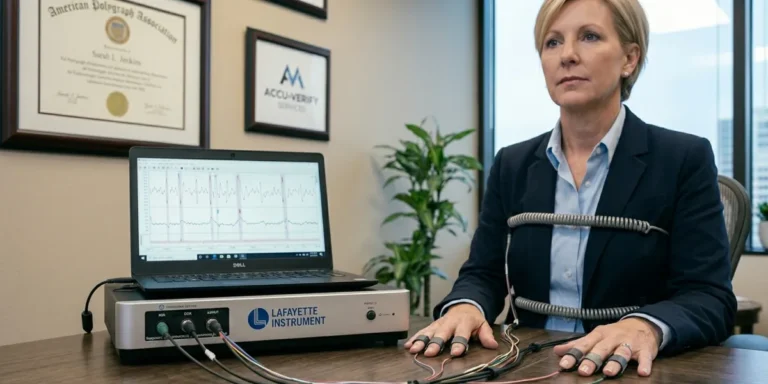
How a Lie Detector Works: Physiology, Technology, and Stages of a Polygraph Test The term "lie detector" is familiar to...
Read more →Certified SPU examiners work across Europe, Asia and North America — choose your country


1
2